

Research outcomes
Hasegawa Mizuki (M1) from the laboratory of Microbial Interaction has received Best Presentation Award
Hasegawa Mizuki (M1) from the laboratory of Microbial Interaction has received Best Presentation Award (The Brewing Basic Science Award) at Young Symposium of the Brewing Society of Japan (October 7, 2025).
Comments on the Award
I am truly delighted and honored to have received this prestigious award. I would like to express my heartfelt gratitude to Associate Professor Daisuke Watanabe and Assistant Professor Naoki Akasaka, who have provided me with guidance on a daily basis, as well as to my research collaborators: Mr. Shinichiro Shimizu (Shimizu Seizaburo Shoten Co., Ltd.), Mr. Shoya Imai (Linné Co., Ltd.), and Mr. Hidekazu Ishiwata (Ikuhi LLC). I will use this award as motivation to continue striving for the further advancement of this research.
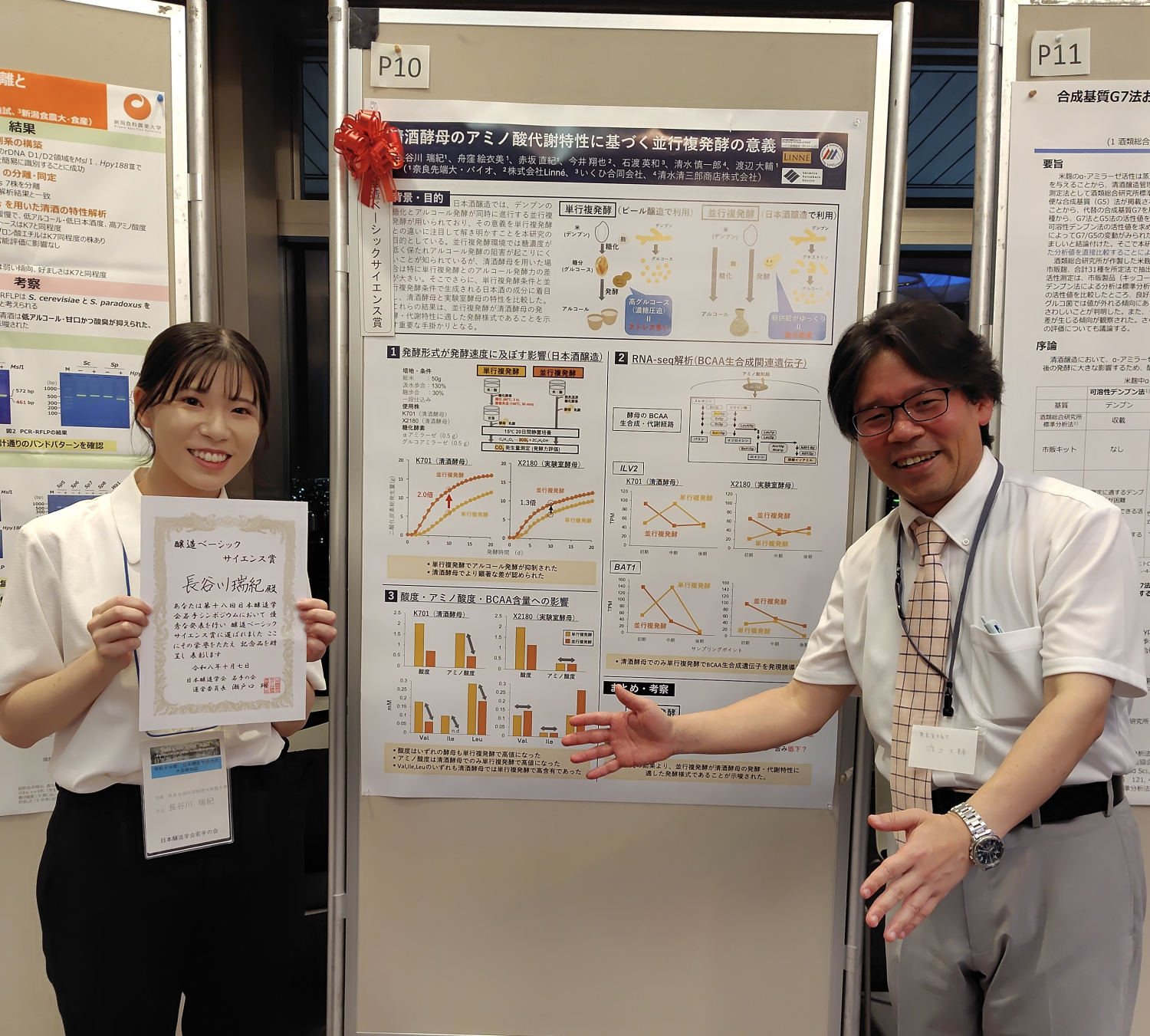
Research Details of Awarded Presentation
In sake brewing, a process known as simultaneous saccharification/fermentation processes—in which starch saccharification and alcoholic fermentation proceed simultaneously—is employed. The objective of this study was to elucidate the significance of this process by focusing on its differences from sequential saccharification/fermentation. It is known that in a simultaneous saccharification/fermentation processes environment, sugar concentrations are maintained at low levels, making it difficult for alcohol fermentation to be inhibited. However, previous studies have suggested that when sake yeast is used, the difference in alcohol fermentation capacity compared to sequential saccharification/fermentation is particularly significant, highlighting the strong need to adopt simultaneous saccharification/fermentation processes. Therefore, we further focused on the components of sake produced under sequential and simultaneous saccharification/fermentation processes conditions and compared the characteristics of sake yeast and laboratory yeast. The results showed that, while both yeast strains exhibited high acidity under sequential saccharification/fermentation, the effect of fermentation conditions on amino acid content was minimal for laboratory yeast; only sake yeast exhibited high amino acid content under sequential saccharification/fermentation conditions. RNA-seq analysis revealed that the ILV2 and BAT1 genes, which are involved in branched-chain amino acid biosynthesis, showed a transient increase in expression only under sequential saccharification/fermentation conditions using sake yeast. Based on these results, it was suggested that in sake brewing using sake yeast, sequential saccharification/fermentation conditions promotes the production of branched-chain amino acids—which affect sake quality—while simultaneously inhibiting alcohol fermentation. These findings support the conclusion that simultaneous saccharification/fermentation processes is a fermentation method well-suited to the fermentation and metabolic characteristics of sake yeast.
Title of Awarded Research
The significance of simultaneous saccharification/fermentation processes based on the amino acid metabolic characteristics of sake yeast
Young Symposium of the Brewing Society of Japan
http://jozowakate.mysterious.jp/wakate.htm
Related Article
https://bsw3.naist.jp/research/index.php?id=2817
Laboratory of Microbial Interaction
https://bsw3.naist.jp/eng/courses/courses313.html
https://bsw3.naist.jp/microbial_interaction/en/top/
( October 13, 2026 )
