

Research outcomes
Assistant Professor Tatsuya Nakagawa from the laboratory of Organ Developmental Engineering has received "The Best Paper Award 2025 in Experimental Animals" of Japanese Association for Laboratory Animal Science
Assistant Professor Tatsuya Nakagawa from the laboratory of Organ Developmental Engineering has received "The Best Paper Award 2025 in Experimental Animals" of Japanese Association for Laboratory Animal Science (April 24th, 2026).
Comments on the award
I am deeply honored to receive the Best Paper Award 2025 in Experimental Animals. I would like to express my sincere gratitude to everyone who provided invaluable support throughout this research. This recognition motivates me to further advance my work, and I will continue striving to contribute to scientific progress through my research.
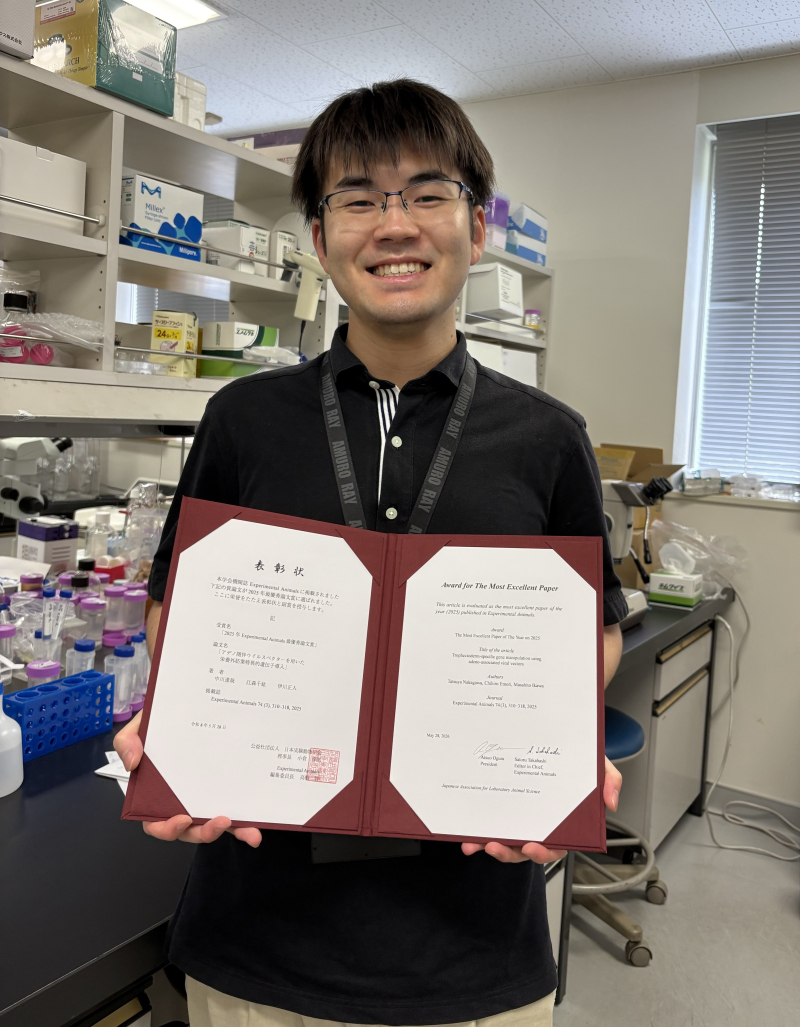
Title and research details of awarded presentation
Trophectoderm-specific gene manipulation using adeno-associated viral vectors
In mammals, trophectoderm cells come into contact with maternal tissues during implantation and subsequently form the placenta, which supports fetal development. Understanding the functions of the trophectoderm and placenta is essential for elucidating the mechanisms underlying normal implantation and pregnancy, as well as pregnancy-related disorders. However, conventional genetically modified mice are typically generated through manipulation of fertilized eggs, resulting in genetic modifications in both the fetus and placenta, which limits placenta-specific functional analyses.
To address this issue, we previously developed a trophectoderm/placenta-specific gene expression system using lentiviral vectors. However, this method required removal of the zona pellucida prior to viral transduction. In the present study, we investigated several adeno-associated virus (AAV) vectors to establish a new trophectoderm/placenta-specific gene delivery method and demonstrated that the AAV1 vector enables trophoblast-specific gene transfer.
This technology is expected to facilitate studies of the molecular mechanisms underlying implantation and placental development, and to contribute to advances in assisted reproductive technologies.
Japanese Association for Laboratory Animal Science
https://www.jalas.jp/index.html
Laboratory of Plant Secondary Metabolism
https://bsw3.naist.jp/eng/courses/courses214.html
https://bsw3.naist.jp/isotani/index-en.html
( June 17, 2026 )
