

Research outcomes
Uesugi Hikaru (M1) from the laboratory of Organ Developmental Engineering has received the "Excellent Presentation Award" of the 159th Kansai Laboratory Animal Research
Uesugi Hikaru (M1) from the laboratory of Organ Developmental Engineering has received the "Excellent Presentation Award" of the 159th Kansai Laboratory Animal Research (December 19, 2025).
Comments on the award
I am deeply honored to have received The Excellent Presentation Award at the 159th Kansai Laboratory Animal Research. I would like to express my sincere gratitude to Associate Professor Ayako Isotani for invaluable guidance, as well as to all members of the Laboratory of Organogenesis Engineering, the staff of the animal facility, and the university faculty and staff for their generous support. I am also profoundly grateful to my parents for their continuous encouragement. Motivated by this award, I will continue to devote myself to further advancing my research and pursuing new scientific insights.
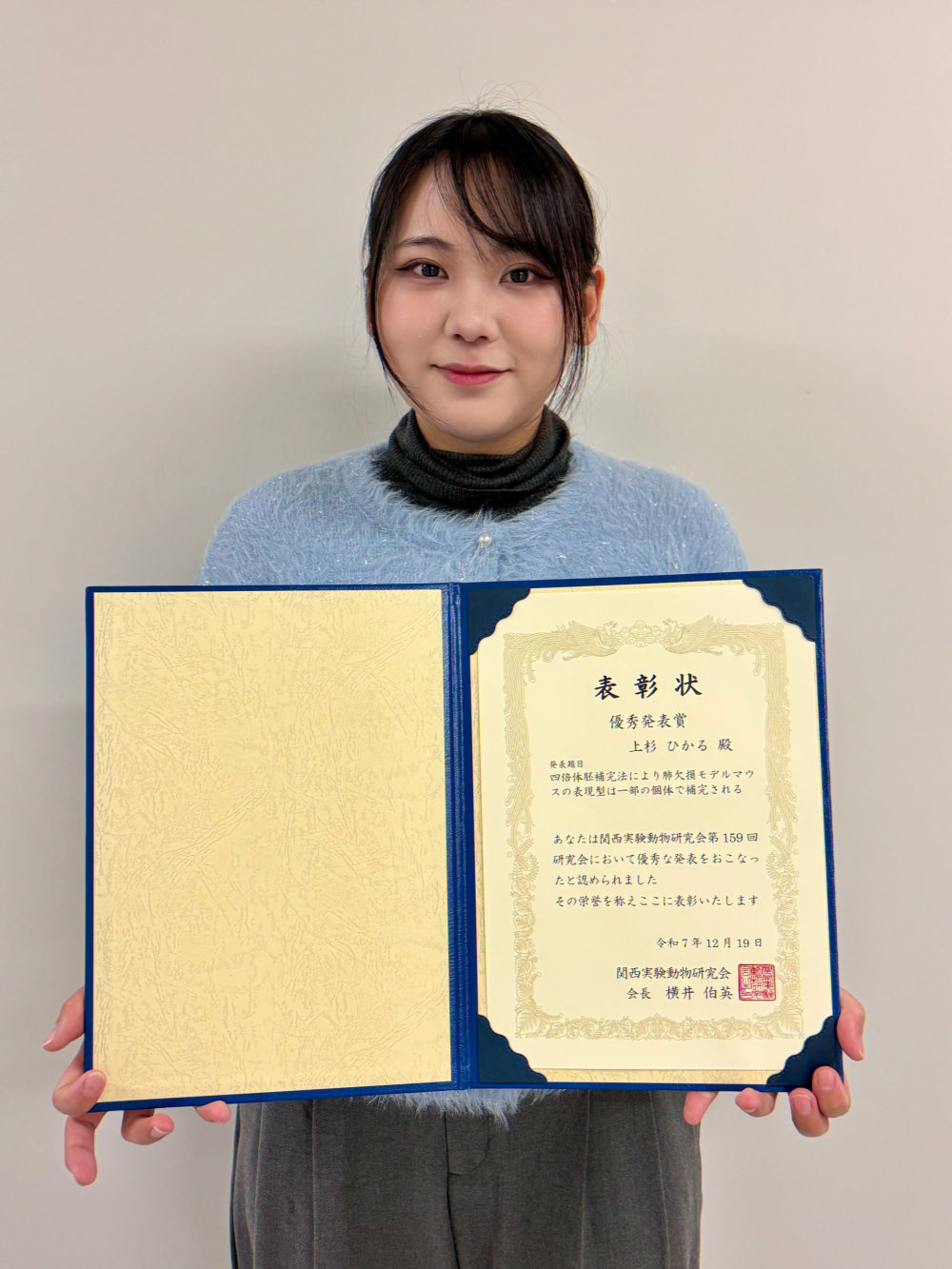
Title of the awarded research
Partial Rescue of the Phenotype in a Lung-Deficient Mouse Model by Tetraploid Embryo Complementation
Tetraploid complementation is a technique to generate ES cell–derived individuals by injecting ES cells into tetraploid embryos, in which tetraploid cells have been thought to predominantly differentiate into extraembryonic tissues such as the placenta and not to contribute to the embryo proper. Although there have been reports of tetraploid embryo–derived cells contributing to the fetus, it has not been sufficiently examined whether these cells can normally differentiate within the fetus and whether the organs or cells to which they contribute are functionally competent.
In this study, we reasoned that the differentiation and function of tetraploid embryo–derived cells contributing to the fetus could be evaluated by using ES cells with an organ-deficient phenotype. We therefore performed tetraploid complementation using lung-deficient ES cells and GFP-labeled tetraploid blastocysts. As a result, we demonstrated that lung tissue was complemented by tetraploid embryo–derived cells, and furthermore, that functional lungs capable of respiration were formed in a subset of the resulting individuals.
Kansai Laboratory Animal Research
http://www.klara.umin.ne.jp/kansai_HP/index2.html
Laboratory of Organ Developmental Engineering
https://bsw3.naist.jp/eng/courses/courses214.html
https://bsw3.naist.jp/isotani/index-en.html
( January 06, 2026 )
