

Research outcomes
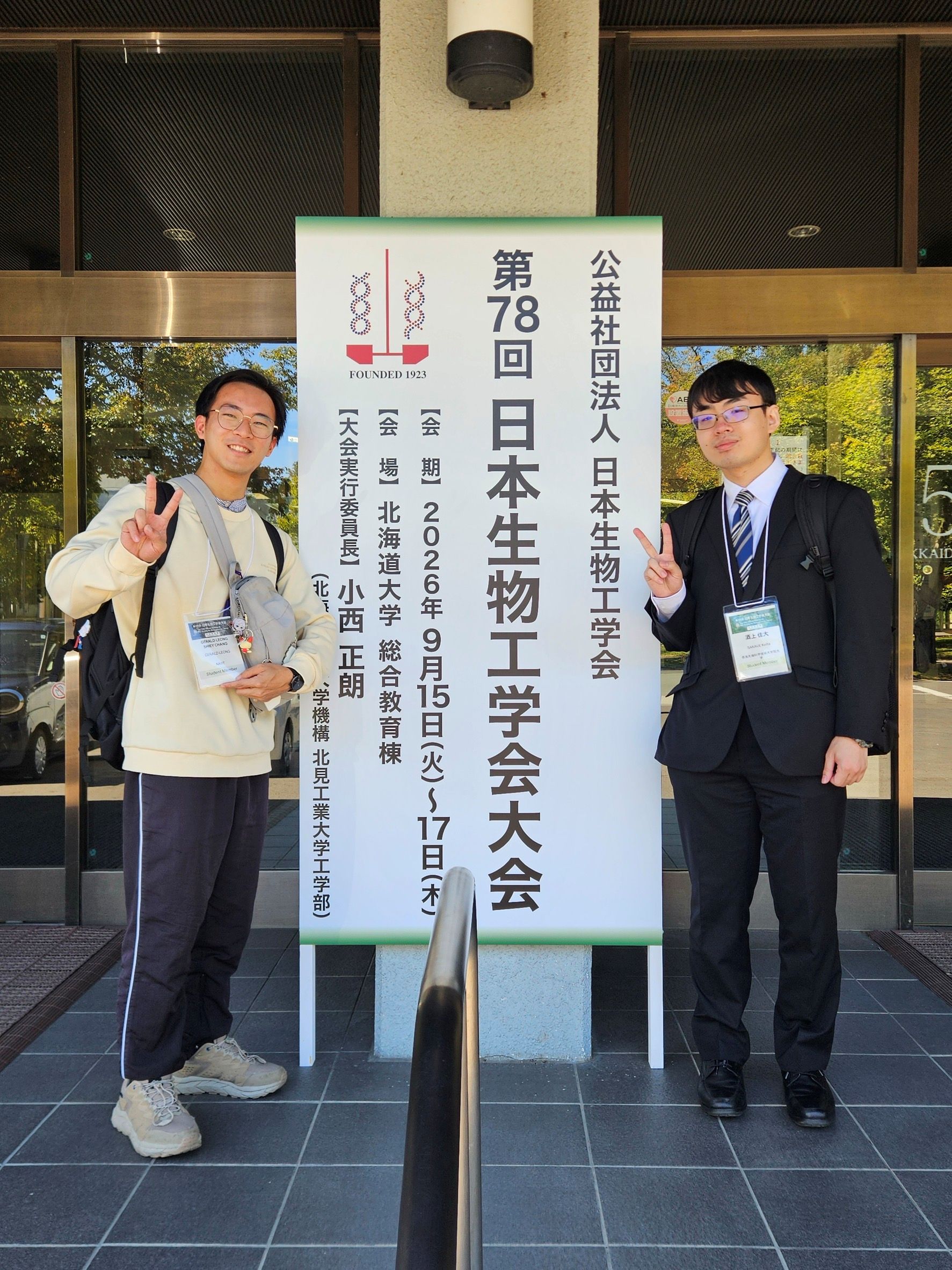
Sakaue Keita (M2) from the laboratory of Microbial Interaction has received Outstanding Student Presentation Award at the 78th SBJ Annual Meeting
Sakaue Keita (M2) from the laboratory of Microbial Interaction has received Outstanding Student Presentation Award at the 78th SBJ Annual Meeting (October 13, 2026)
Comments on the Award
I am truly delighted and honored to receive this prestigious award. I would like to express my sincere gratitude to Associate Professor Daisuke Watanabe, Professor Yukiko Nakase, Associate Professor Yuichi Morozumi, Assistant Professor Naoki Akasaka, and all members of the laboratory for their valuable guidance and advice throughout this research. This award will serve as a great encouragement for me to continue pursuing my research with dedication and to further develop my work.
Research Details of the Awarded Presentation
Alcoholic fermentation by the yeast Saccharomyces cerevisiae is an important process supporting the production of alcoholic beverages and bioethanol. We previously found that the addition of spice-derived compounds, such as curcumin and piperine, promotes alcoholic fermentation in yeast. The aim of this study was to elucidate the mechanisms underlying this fermentation-promoting effect. Our analyses revealed that Hog1p, a MAP kinase involved in the hyperosmotic stress response, plays an important role in the fermentation-promoting effects of both compounds. However, no marked increase in Hog1p phosphorylation was observed, suggesting that a regulatory mechanism distinct from the typical hyperosmotic stress response may be involved. Furthermore, to identify factors involved in piperine-induced fermentation promotion, we conducted a screening using transcription factor deletion strains. The results indicated that Hmo1p, which is involved in ribosome biogenesis, and Stp1p, which is involved in amino acid responses, contribute to this effect. These factors are known to be regulated by the TORC1 signaling pathway, which controls cellular nutrient status and growth. This suggests that TORC1 may also be involved in the mechanism by which piperine promotes fermentation. Overall, our findings suggest that the promotion of alcoholic fermentation by spice-derived compounds involves multiple intracellular regulatory mechanisms, including Hog1p-mediated stress responses and nutrient responses. These findings may contribute to the development of novel fermentation control technologies using spice-derived compounds without genetic modification.
Title of Awarded Research
Analysis of Hog1p-Dependent Regulation in the Promotion of Yeast Alcoholic Fermentation by Spice Compounds
The Society for Biotechnology, Japan
Related Article
https://www.sbj.or.jp/2026/en/news/student_award_20261013.html
Laboratory of Microbial Interaction
https://bsw3.naist.jp/eng/courses/courses313.html
https://bsw3.naist.jp/microbial_interaction/en/top/
( November 09, 2026 )
