


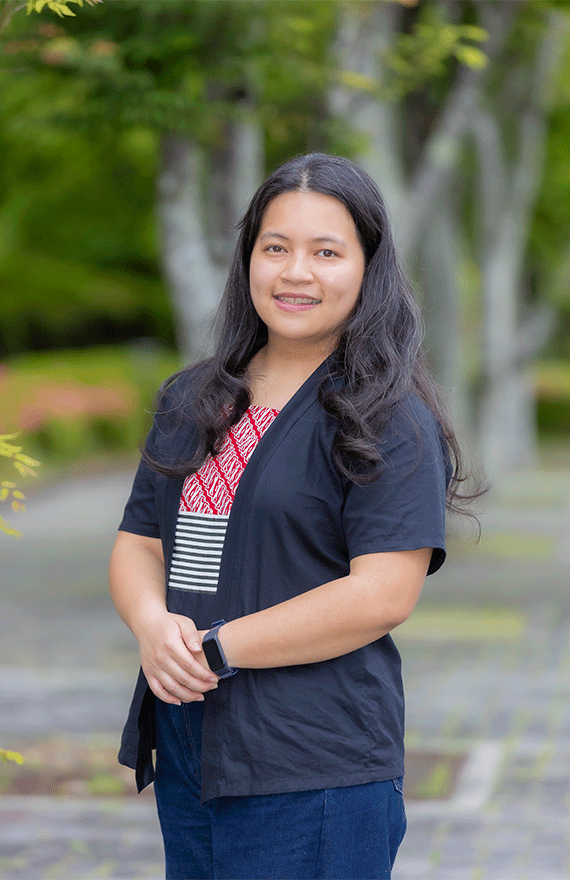
J.H.P.K / M2
What do you like about Division of Biological Science at NAIST?
What I like about the Division of Biological Science at NAIST is the diversity of research fields within biology. The division covers many areas, from molecular biology and microbiology to plants, animals, and other biological systems. Because of this, I can learn not only from my own research field, but also from seminars, classes, and discussions related to different areas of biology. I think this is a very valuable environment because it helps me see biological science from a broader perspective. It also encourages me to think about how different fields are connected.
What is your research topic?
My research focuses on understanding the role of agmatine production in Aspergillus oryzae, a filamentous fungus widely used in traditional Japanese fermented foods. Agmatine is produced from arginine by an enzyme called arginine decarboxylase, and in our study, we are especially interested in a gene called Ao-adc1. By constructing and analyzing an Ao-adc1 disruptant strain, I investigate how this gene may be related not only to agmatine production, but also to fungal growth and asexual development under solid-state cultivation.
Did you change your research field after entering NAIST?If so, how was the experience of changing it?
I would say that my research field did not completely change, but my research focus became more specific and shifted in perspective. During my bachelor’s degree, I studied Bioprocess Engineering, so I learned more about process design, fermentation, and the engineering side of biotechnology. After entering NAIST, my research became more focused on microbiology. At first, it was challenging because I had to learn new experimental techniques and a different way of thinking about microorganisms. However, my previous background still helps me understand the broader importance of the research. This transition has been a valuable experience because it allowed me to connect engineering, microbiology, and traditional fermentation from a new perspective.
How is the atmosphere in your lab?
I would describe the atmosphere in my lab as open and supportive. My professor and lab members are very open to discussion, so I feel comfortable asking questions and learning step by step. What I like most is that the lab has a good balance between being serious about research and having a friendly atmosphere. Everyone works hard on their own projects, but we can also talk, share ideas, and enjoy small conversations with each other. This kind of environment makes me feel motivated, while also helping me enjoy the process of doing research.
What is your goals for the future?
From what I have learned so far in my current lab, I have become more inspired to bring forward research on fermented foods from my own country, Indonesia. In the future, I hope to develop myself as a researcher who can connect traditional knowledge with modern biological science. I would like to contribute to research that not only improves our understanding of microorganisms and fermentation, but also helps highlight the value of local fermented food culture in a broader scientific context.
What are your tips for enjoying life at NAIST?
A tip from me is to try doing things that you may not have been able to do before. At NAIST and in Japan, there are many opportunities and experiences that are different from what I had back home. Whenever time permits, I try to take those opportunities, whether it is joining events, exploring new places, learning Japanese culture, or simply meeting and talking with different people. Through these experiences, I have learned a lot not only academically, but also personally. I think enjoying life at NAIST is about finding balance: working hard in research, but also allowing yourself to grow through new experiences outside the lab.
Tell us about something you think that only you have experienced.
I think one funny experience that I have had as an international student is getting confused between different languages. Since my lab has quite a diverse group of international students, we use English, learn Japanese, and sometimes also teach each other small words from our own mother languages. On some days, especially after a long and busy day in the lab, my mind becomes a jumble of languages. I sometimes forget which language I should use, mix up words, or accidentally use the wrong language when speaking to other lab members. It can be confusing at the moment, but it usually becomes a funny memory for all of us. I think this is one of the unique and enjoyable parts of studying in an international environment.
(June, 2026)
※The content of this interview is current at the time of publication.