
2026.05.01
Cellular protrusions-derived extracellular vesicles serve as highly efficient carriers for protein transport.
Molecular Medicine and Cell Biology ・ Assistant Professor ・ Hiroki Kawana
Extracellular vesicles (EVs) are small particles enclosed by a lipid bilayer and released from cells. They contain proteins and RNAs and are known to be involved in both physiological and pathological processes, such as aging and cancer, by serving as intercellular transport carriers. To date, research and applications of EVs have primarily focused on endosome-derived EVs. However, efficient delivery of proteins in a biologically active form has remained challenging. In our previous work, we identified a novel mechanism by which EVs formed through the cleavage of cellular protrusions transport specific proteins between cells and regulate cellular properties1. Furthermore, recent studies have quantified the absolute amount of proteins transported by these protrusion-derived EVs, demonstrating that this quantity is sufficient to alter cellular properties. Additionally, we showed that genome-editing enzymes can be efficiently loaded onto protrusion-derived EVs and delivered to recipient cells by fusing them with proteins that constitute the protrusions. From detailed analyses, it was suggested that protrusion-derived EVs enable more efficient protein delivery than endosome-derived EVs2. This paper presents our research on the transport of functional proteins using protrusion-derived EVs.
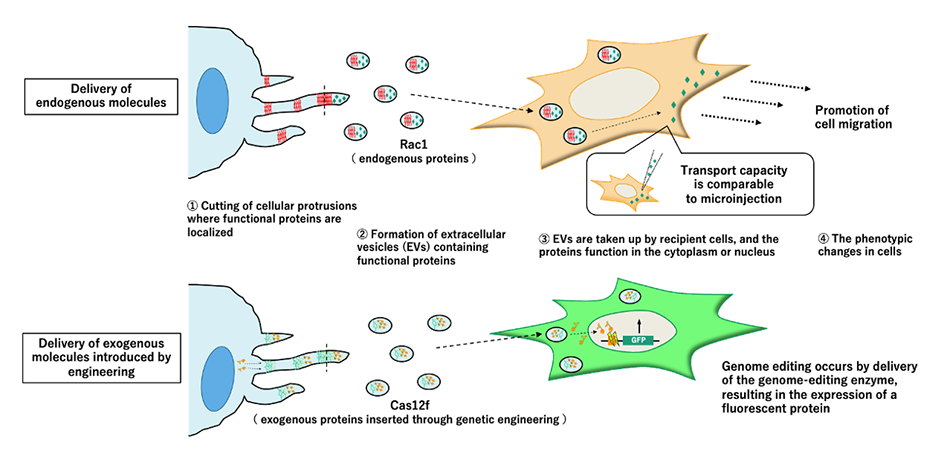
Figure: Delivery of functional proteins using cellular protrusions-derived extracellular vesicles (EVs)
- ① Cellular protrusions are cleaved along with the proteins enclosed within them.
- ② Extracellular vesicles containing endogenous proteins or cargo proteins inserted by engineering.
- ② The EVs are taken up by receiving cells, and the proteins exert their function (Amount of incorporated protein is comparable to microinjection)
- ④ It causes changes in the cellular phenotype.
References
Hiroki Kawana NAIST Edge BIO, e0036. (2026).